Category guide
Focus Supplements Explained, With Neuromind as the Example
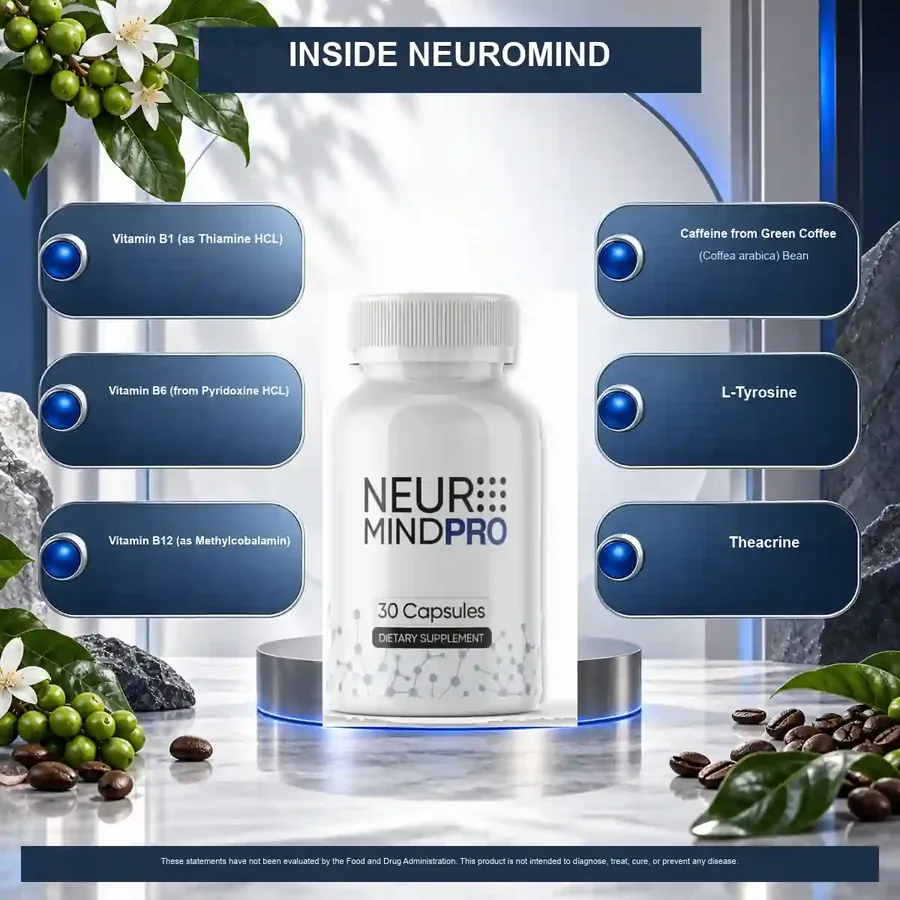
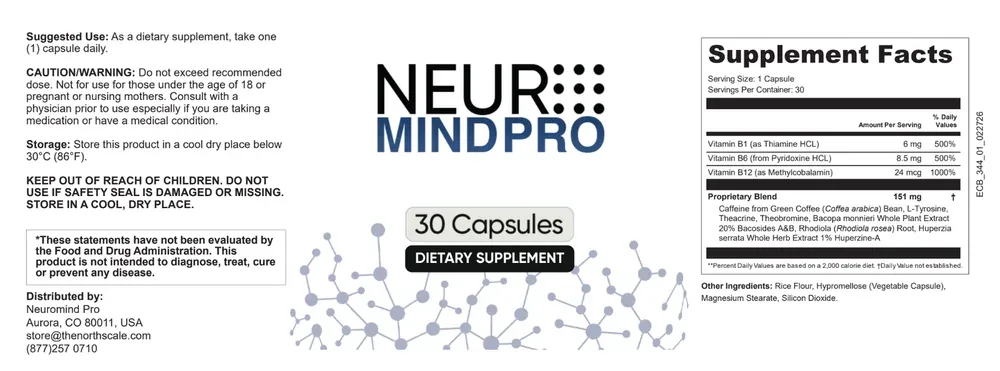
A focus supplement usually mixes stimulants, amino acids, long-studied herbs, B vitamins and sometimes a drug-like compound. FDA rules let a proprietary blend print one total weight with the parts in descending order, so amounts stay hidden. Neuromind prints amounts for B1, B6 and B12, then puts seven ingredients including the caffeine inside one 151 mg blend.
What is a focus supplement?
It is a capsule, powder or drink sold to make concentration easier. There is no legal definition and no agreed recipe, so the word covers a wide shelf. Almost every product on it is built from the same five families.
| Family | Common examples | What it is asked to do | How fast |
|---|---|---|---|
| Stimulants | Caffeine, theobromine, theacrine | Raise alertness, hold off tiredness | Inside an hour |
| Amino acids | L-tyrosine, L-theanine | Supply raw material for signalling chemicals | Same day, under pressure |
| Traditional herbs | Bacopa, rhodiola, ginseng | Support attention or fatigue over months | Weeks to months, if at all |
| B vitamins | B1, B6, B12 | Cover a shortfall in the diet | Nothing, if you were not short |
| Drug-like compounds | Huperzine-A and similar | Act on one enzyme or receptor | Studied as medicine |
Knowing the families matters more than knowing the brand names, because each behaves differently. Most products mix at least three. Neuromind mixes four and adds the fifth in small print, as the ingredients page sets out.
An hour or twelve weeks: two very different clocks
This is the part that catches people out. The stimulant half of a focus supplement works on a clock you can feel: caffeine is absorbed quickly, arrives inside the hour and fades across the day. Nobody needs a study to notice it.
The herb half is the opposite. The meta-analysis of bacopa monnieri that found anything at all looked at trials running at least twelve weeks of daily dosing at set amounts, and its authors asked for larger studies (Kongkeaw et al., 2014). Amino acids sit somewhere in between: a review of the human trials on L-tyrosine found it mostly helped under short, demanding conditions such as cold, noise or lost sleep, and did little in people who were rested (Jongkees et al., 2015).
So a first capsule that feels like something is usually the caffeine. That is worth knowing before you draw a conclusion about the other nine ingredients.
What is a proprietary blend, and why is it allowed?
A proprietary blend is a group of ingredients declared as one total weight instead of one weight each, which is legal. Under FDA labeling rules a blend may be listed with a single amount for the whole group, with the ingredients underneath in descending order of how much there is (FDA labeling guide).
The usual reason given is recipe secrecy. Either way the effect on a buyer is the same: names and one number, with nothing to line up against published research. The descending order rule is the part most people miss, and it is useful. The first name under a blend line weighs more than the second, and so on down.
The worked example
What a blend does still tell you
A single number is not nothing. Two useful facts survive.
- A ceiling. Nothing inside a 151 mg blend can weigh more than 151 mg.
- An order. Caffeine from green coffee is printed first, so it outweighs the other six.
- A tail. Huperzia is printed last, so it is the smallest share of the seven.
- A count. Three of the seven names are stimulants.
What none of that gives you is a dose. A ceiling tells you the worst case. Only a dose tells you what you are taking.
How do you read a focus label before you buy?
Six passes, in this order. It takes about two minutes on any US supplement bottle, blend or no blend.
Find the serving size first
Everything on the panel is measured per serving, so a two-capsule serving is not comparable to a one-capsule serving until you fix that.
Count the rows that carry a number
Rows with milligrams against rows without. That ratio is the fastest quality signal on the label.
Look for the word blend
A blend line gives one weight for everything under it, with the names in descending order by weight.
Put the stimulants in one pile
Caffeine, theobromine, theacrine, guarana and green tea extract belong to the same conversation. Count how many are present.
Read the other ingredients line
Capsule material, fillers and flow agents. This is where a vegetarian or anyone with an allergy finds their answer.
Check the caution paragraph
Age limits, pregnancy, medicines and storage. Short, legally required, and almost nobody reads it.
The longer version of this method, with the awkward cases, is in the post on reading a label that hides the dose.
Neuromind as the worked example
Run the method on this product and it splits in half. Three vitamins carry real amounts and a Daily Value. Seven more carry names and share one line.
| On the panel | Amount printed | Family |
|---|---|---|
| Vitamin B1, B6 and B12 | 6 mg, 8.5 mg and 24 mcg | B vitamins |
| Caffeine from green coffee bean | Not published | Stimulant |
| L-tyrosine | Not published | Amino acid |
| Theacrine | Not published | Stimulant |
| Theobromine | Not published | Stimulant |
| Bacopa monnieri, 20% bacosides A&B | Not published | Herb |
| Rhodiola rosea root | Not published | Herb |
| Huperzia serrata, 1% huperzine-A | Not published | Drug-like |
Serving size is one capsule and a bottle holds 30. The three vitamin amounts are checkable: 6 mg of B1, 8.5 mg of B6 and 24 mcg of B12, at 500%, 500% and 1,000% of the Daily Value. The other seven are not checkable at all, and one of them is the caffeine.
That is a normal, legal label, and more open than products that never name their blend contents. It is also why nobody can give you a caffeine dose. The full panel is on the Supplement Facts page.
Why stacking a blend on top of coffee is the real risk
This is the practical problem with an unmeasured stimulant, and it has nothing to do with whether the product works. Caffeine adds up across a day, and you can only total numbers you have.
The FDA points to 400 mg of caffeine a day as an amount not generally tied to negative effects in healthy adults, and lists a faster heartbeat, palpitations, higher blood pressure, jitters, an upset stomach and broken sleep as the signs of too much (FDA). Add a capsule with an unprinted caffeine amount and the sum stops working. This one also carries theobromine and theacrine, two more stimulants from the same family, and neither is measured either.
The timing side, and what to do if you already drink several cups, is in the caffeine and sleep guide.
What does research say about B vitamins and thinking?
Less than the packaging suggests. Reviews of supplements and cognitive function have not found clear evidence that B vitamins improve thinking in healthy people who are not short of them (NCCIH). That is a comment on the research, not a verdict on a product.
Where B vitamins matter is deficiency, which is a medical question with a blood test behind it. Large percentages are easy to misread as strength: a 1,000% Daily Value means ten times a daily reference intake, not ten times the benefit.
These three are water soluble and a surplus mostly leaves in urine. The one with a real ceiling is B6, where the adult upper limit is 100 mg a day and this label sits at 8.5 mg (NIH ODS). The only reason to think about it is if you take other B6-containing supplements too.
Five questions to ask before you spend money
Ask these of any focus supplement. The answers are all on the label, which is the point.
- How many ingredients carry a printed amount, and how many do not?
- Is the serving size one capsule, or two?
- How many separate stimulants are in this product?
- What does the other ingredients line say about the capsule shell?
- What is already in my day, in coffee, tea and soda?
A blend does not make a product bad. It makes it unverifiable, which is a smaller problem and a different one, but it is yours to carry rather than the seller's. The ingredient-by-ingredient version of this page is ten names, one number.
Focus supplements: common questions
Is a proprietary blend legal?
Yes. FDA labeling rules allow a blend to declare one total weight for the group, with the ingredients listed underneath in descending order by weight (FDA). That is exactly what the 151 mg line here does.
Does the order of names in a blend mean anything?
Yes, it is heaviest first. Here that makes caffeine from green coffee the largest of the seven and huperzia serrata the smallest, though not by how much.
Can you estimate the caffeine from the 151 mg total?
No. The blend could be mostly caffeine or mostly L-tyrosine and the label reads the same. The only honest statements are the 151 mg total, the order and the ceiling.
Do B vitamins improve concentration?
Reviews have not found clear evidence of that in healthy people who are not deficient (NCCIH). Deficiency is a medical question, diagnosed with a test, not from a supplement shelf.
Sources for this page
- U.S. Food and Drug Administration. Dietary Supplement Labeling Guide: Chapter IV. Nutrition Labeling. Source
- U.S. Food and Drug Administration. Spilling the Beans: How Much Caffeine is Too Much? Source
- National Center for Complementary and Integrative Health. Dietary Supplements and Cognitive Function, Dementia, and Alzheimer's Disease: What the Science Says. Source
- Kongkeaw C, Dilokthornsakul P, Thanarangsarit P, Limpeanchob N, Scholfield CN. Meta-analysis of randomized controlled trials on cognitive effects of Bacopa monnieri extract. J Ethnopharmacol, 2014. Source
- Jongkees BJ, Hommel B, Kuhn S, Colzato LS. Effect of tyrosine supplementation on clinical and healthy populations under stress or cognitive demands - A review. J Psychiatr Res, 2015. Source
- NIH Office of Dietary Supplements. Vitamin B6: Fact Sheet for Consumers. Source
Keep reading
Ready when you are
Order Neuromind from the U.S. retail desk
One capsule a day. Follow the label on your bottle. 60-day money-back guarantee. A real person at +1 (877) 257-0710 for orders, tracking and refunds.