How to read a panel
How to Read a Neuromind Label That Hides the Dose
Read a Supplement Facts panel in six passes: serving size, servings per container, amount per serving, percent Daily Value, any blend line, then other ingredients. A blend prints one total weight with its contents in descending order. On this label that is 151 mg covering seven ingredients, and two different label artworks exist for the same product name.
How do you read a Supplement Facts panel?
Top to bottom, in a fixed order, and it takes about two minutes. A Supplement Facts panel is not a marketing surface. It is a standard format, so the same six things are always in the same six places. Read them in that order and you catch nearly everything a front label hopes you miss.
Serving size and servings per container
The first two lines. Serving size tells you what every amount below refers to. Here it is one capsule and 30 servings, so a bottle is a month.
Amount per serving, row by row
The middle column. A row with a milligram or microgram figure can be checked against published intakes. A row without one cannot.
Percent Daily Value
The right-hand column, comparing the amount with a daily reference intake for adults. A dagger or a blank means none has been established.
Any line with the word blend
Read the names underneath as a ranking, heaviest first, then accept that the one weight is all you are getting.
The other ingredients line
Under the panel. Capsule material, fillers and flow agents, plus the answer for anyone avoiding gelatin or an allergen.
The caution paragraph
Age limits, pregnancy, medicines, storage and the safety seal. Short, required, and the part most people skip.
That method works on any US supplement bottle. The rest of this post runs it on a real label, using the one on this site.
- First line to readServing sizeEvery other figure on the panel is per that serving
- Rows with a number3 of 10Vitamins B1, B6 and B12, with Daily Values
- Rows without a number7 of 10All sharing one 151 mg proprietary blend line
- Last line to readOther ingredientsCapsule shell, filler and flow agents
What does percent Daily Value actually mean?
It compares the amount in one serving with a daily reference intake set for adults. That is all. It is a unit of comparison, not a unit of strength, and large percentages are the most misread thing on any panel.
| What you see in the % DV column | What it means | What it does not mean |
|---|---|---|
| A percentage under 100% | The serving supplies part of a day's reference intake | That the amount is too small to matter |
| 100% | One full daily reference intake for adults | A dose used in any particular study |
| 500% or 1,000% | Five or ten times the daily reference intake | Five or ten times the benefit |
| A dagger symbol | No Daily Value has been established for that ingredient | That the ingredient is unregulated or untested |
| A blank cell | Same as a dagger in practice | That the maker forgot to print it |
On this label, vitamin B1 at 6 mg shows 500%, vitamin B6 at 8.5 mg shows 500%, and vitamin B12 at 24 mcg shows 1,000%. Those are real multiples of a reference intake. They are not evidence that ten times a reference intake does ten times anything.
The dagger row is the one to pay attention to here. The proprietary blend line carries a dagger because no Daily Value exists for a made-up group of seven ingredients. That symbol is correct, and it is also the moment the panel stops telling you amounts.
What does the order inside a blend tell you?
A ranking, and nothing more. Under the FDA labeling rules, the ingredients inside a proprietary blend are listed in descending order of how much there is, and only the total weight of the blend has to be declared (FDA labeling guide).
So on this panel, caffeine from green coffee bean is printed first and therefore outweighs the other six. Huperzia serrata is printed last and is the smallest share. Everything between those two is ranked but unmeasured.
Two habits make that ranking useful. Read the first two names in any blend as the ones that dominate, and note where the stimulants sit, because a stimulant printed first is a different product from one printed last.
Dietary supplements are not reviewed by the FDA for effect before they go on sale, so the panel and the published research are the only two documents a buyer has (FDA). The longer version of this argument is in what the blend hides.
What does the other ingredients line cover?
Everything in the capsule that is not counted as an active. It sits under the panel rather than inside it, and it is where the practical answers live for anyone with a restriction.
| Other ingredient on this label | What it is doing | Who might care |
|---|---|---|
| Rice flour | Filler, so a small active amount fills a capsule | Anyone avoiding grains |
| Hypromellose | The capsule shell, made from plant cellulose | Vegetarians and vegans, since it is not gelatin |
| Magnesium stearate | Flow agent, keeps powder moving through machinery | Rarely anyone, though it is often argued about online |
| Silicon dioxide | Anti-caking agent, keeps powder dry and loose | Rarely anyone |
There is no allergen statement on this label and no gluten free or vegan mark on the panel itself. Hypromellose being a plant cellulose capsule is the closest thing to a useful answer for a vegetarian, which is why this line is worth reading.
What that line never does is reveal an active amount. A long filler list does not mean a small dose, and a short one does not mean a large one.
The awkward case: two label artworks, one product name
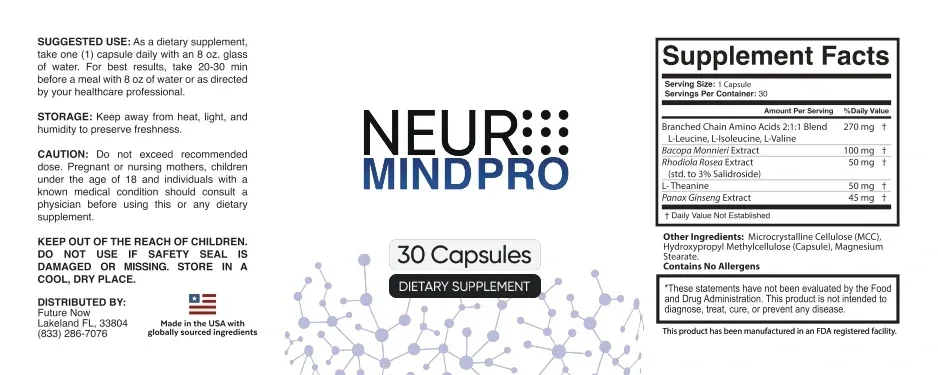
This is where the method meets something odd, and it is worth knowing before you order. Two different label artworks were supplied for this product name, and they print different formulas.
One prints the B vitamins and the 151 mg blend described everywhere on this site. The other prints branched chain amino acids, bacopa, rhodiola, L-theanine and panax ginseng, with amounts for each, and names a different distributor in a different state. It also gives different directions, adding a glass of water and a window before a meal.
This site follows the first artwork, because its ingredient list matches the sales page. Both are shown on the Supplement Facts page. If the bottle that arrives matches the other one, call +1 (877) 257-0710 before taking any of it.
The rule it points to is general and worth keeping. A panel on a website is a claim. The panel on the bottle in your hand is the document.
A five-minute check before you buy anything
Five habits. They work on any supplement and cost almost nothing.
- Photograph the panel on your phone before you leave the shop or close the tab.
- Count the rows with numbers against the rows without.
- Circle every stimulant name you can find, wherever it sits on the panel.
- Read the other ingredients line out loud if you avoid anything.
- Check that the panel in front of you matches the panel on the website you bought from.
The NIH asks shoppers to know what is in a product, to watch for interactions with medicine, and to tell every clinician about everything they take (NIH ODS). A panel that prints amounts makes all three of those easy. A panel with a blend on it makes the first one impossible and leaves you relying on names alone.
Names are still worth something. You can take a name to a pharmacist even when the amount is missing. Vitamin B6 is the example in the other direction: the adult upper limit is 100 mg a day and the printed amount is 8.5 mg, so the only question is what else in your cupboard contains B6 (NIH ODS).
If you want the same panel taken apart ingredient by ingredient, read ten names, one number. For how we decide what to print and what to leave blank, see testing and quality.
Questions people ask about this
What is the first thing to read on a supplement label?
The serving size. Every amount on the panel is per serving, so a two-capsule serving and a one-capsule serving cannot be compared until you account for it. This product is one capsule per serving.
What does the dagger symbol in the % Daily Value column mean?
That no Daily Value has been established for that ingredient. On this panel the dagger sits beside the 151 mg proprietary blend, because no reference intake exists for a group of seven ingredients.
Does a high Daily Value percentage mean a stronger product?
No. It means the amount is a multiple of a daily reference intake. Vitamin B12 at 1,000% is ten times a reference intake, which is a statement about arithmetic rather than about effect.
What does the order inside a blend tell me?
It is a ranking by weight, heaviest first, required by FDA labeling rules (FDA). It tells you which ingredient dominates and which is smallest. It does not tell you by how much.
Which label artwork should I trust?
The one printed on the bottle you are holding. Two artworks were supplied for this product name with different formulas and different distributors, and this site does not merge them.
What should I do if my bottle does not match this site?
Call +1 (877) 257-0710 before taking any of it, and follow the directions printed on your own bottle. The contact page explains which desk handles which question.
Sources for this page
- U.S. Food and Drug Administration. Dietary Supplement Labeling Guide: Chapter IV. Nutrition Labeling. Source
- U.S. Food and Drug Administration. Dietary Supplements. Source
- NIH Office of Dietary Supplements. Dietary Supplements: What You Need to Know. Source
- NIH Office of Dietary Supplements. Vitamin B6: Fact Sheet for Consumers. Source
Keep reading
Ready when you are
Order Neuromind from the U.S. retail desk
One capsule a day. Follow the label on your bottle. 60-day money-back guarantee. A real person at +1 (877) 257-0710 for orders, tracking and refunds.